


The world’s most advanced automated warehouse for roll media has commenced operations. For converters, vinyl film distributors and digital printers, this means greater efficiency and a reduction in the workload involved in storing and retrieving roll media.
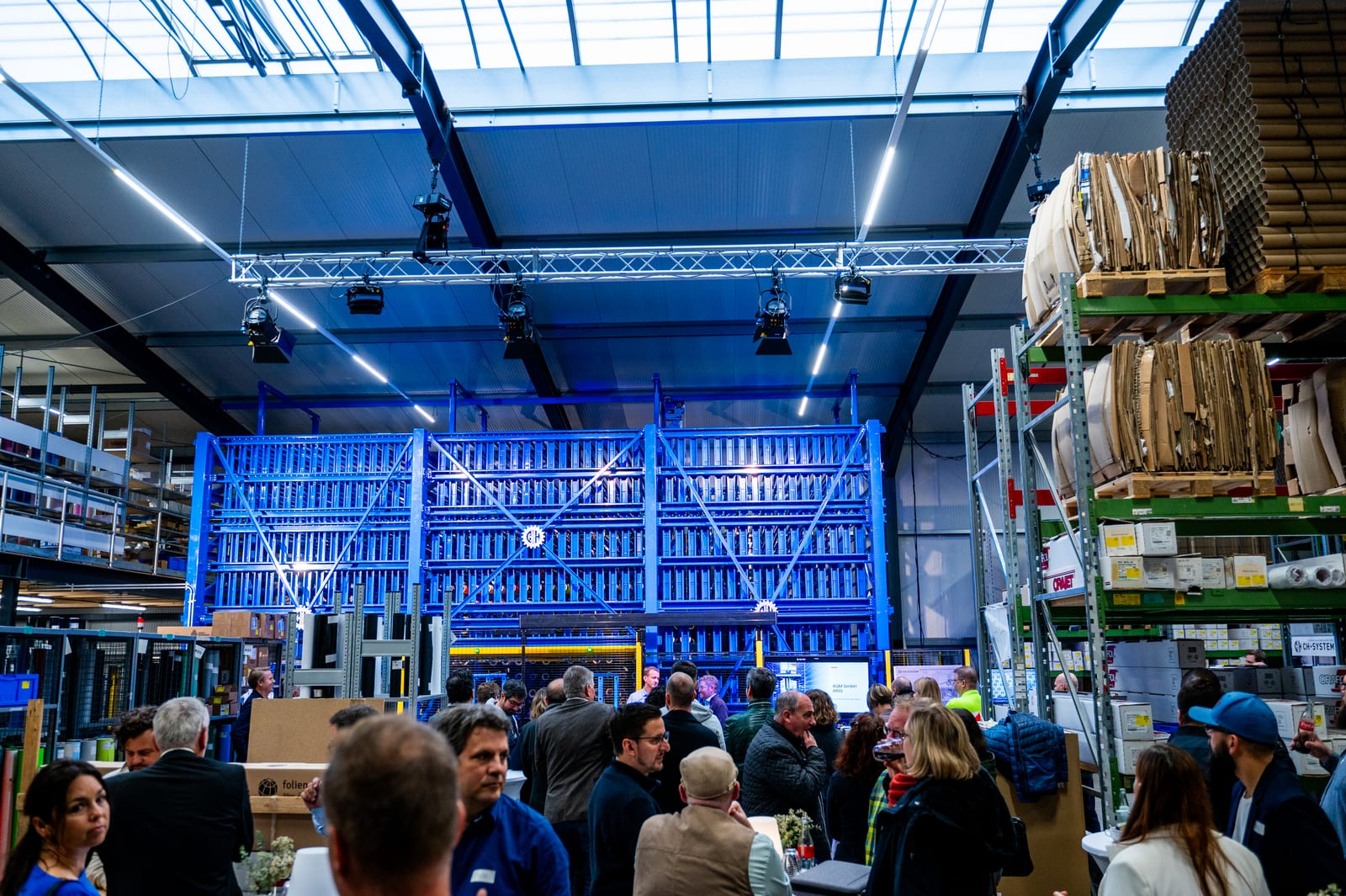
The launch took place in mid-November 2023 at 4 GM / Folienwelt.de in Trier. The vinyl film reseller is the first company to use the Automated Roll Storage System (ARSS), developed by Nepata, in its warehouse. Following several weeks of trial operation, the warehouse has been almost full since mid-January and is now operating as normal.
Guests from several European countries, invited by Nepata, took advantage of this unique opportunity to see the ARSS in action in a real-world operating environment. The way robots and humans work together in the picking process was met with widespread enthusiasm. “Manual handling is a thing of the past,” sums up Nepata’s Managing Director, Fabian Franke.
Automation of storage processes for roll media
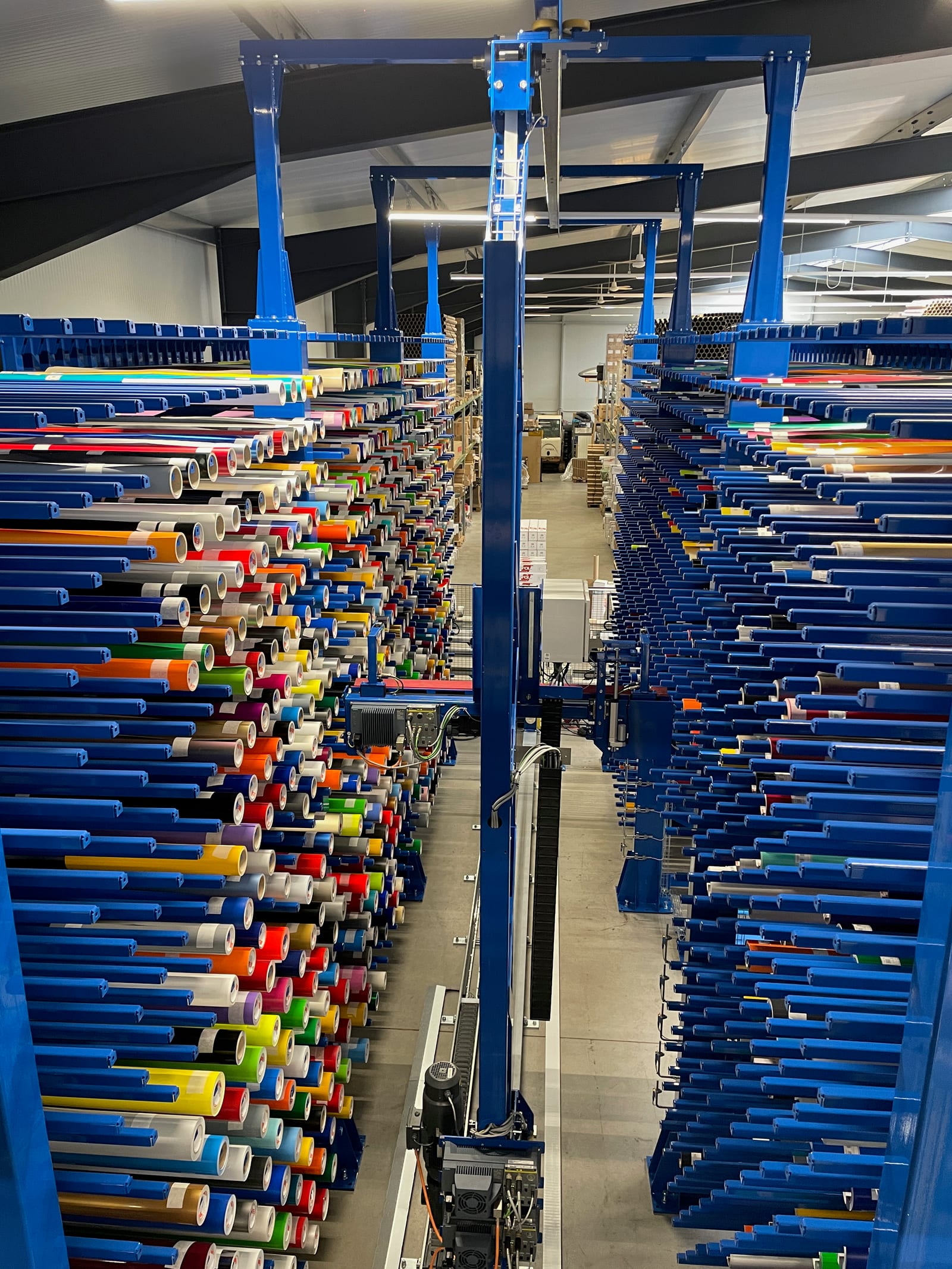
The Automated Roll Storage System (ARSS) receives orders from the ERP system; a robot retrieves the required rolls from the high-bay warehouse and hands them over to the staff at the converting machines.
The system is designed for small to medium-sized roll storage facilities with a total capacity of 400 to 5,000 rolls – depending on the configuration. The ARSS was developed by the German specialist machinery manufacturer Nepata, a producer of film converting machinery. The system was assembled and programmed by CH System in Denmark. The company specialises in robot-assisted packaging and handling systems.
High-bay racking with spindles and a vertical robot
It was therefore up to Christian Weinreich, Technical Manager at CH System, to explain the robots, hardware and technical components. The basis for the automated roll storage system is a steel racking structure with horizontal pins on which the rolls are suspended. A vertical 3-axis robot retrieves the rolls required for each order. Using a tray gripper, it lifts the roll and places it in a transfer station directly next to the rewinding machine. In the pilot project at Folienwelt.de, almost 2,000 rolls of plotter film and other roll media are stored on a shelving system covering a floor area of just 60 square metres.
At the launch event, 4GM Managing Director Robin Schröring-Abke explained the reasons for moving away from conventional shelving storage: “Every week was ‘Domino Day’,” he reported. This was because the majority of the more than 4,000 rolls in the warehouse were simply stored on shelves – with the risk that everything would topple over if anyone wasn’t careful. Further impressive figures from his presentation: 68 per cent more rolls can be stored in the same space than with shelving units. And thanks to automation, the picking process is now 58 per cent faster. This means capacity can be increased from 700 to 1,200 storage and retrieval operations.
Schröring-Abke’s conclusion: “The ARSS was the best investment.” “What could be better than an enthusiastic customer who sings the praises of the machine themselves?” replied Nepata representative Franke. And the guests from the film distribution and converting sectors were impressed by just how sophisticated the process optimisation at 4GM is – going beyond the new hardware. It also became clear during the presentation that adjustments to suit individual workflows and circumstances are necessary – and possible – for every business. Every Automatic Roll Storage System is individually planned and engineered by Nepata and CH System.
Less lugging about, more space
Even the pilot project makes it clear that the ARSS can solve typical challenges in roll storage: inefficient fetch-and-return processes, heavy manual labour, picking errors and space constraints. The use of robots fundamentally changes the fetch-and-return process and boosts efficiency.
In almost all converting processes, roll media must be stored and retrieved. This can mean thousands of rolls and hundreds of picks per day within a value chain. Traditional roll storage and the journey to (and from) the converting area incur significant costs and time losses. Despite high-speed sorting, inefficient retrieval and delivery times persist. And last but not least, shelving units take up valuable space, whilst the surfaces of the rolls are damaged.
At folienwelt.de, this is now a thing of the past – a fact that was celebrated in style during the commissioning phase with manufacturers, suppliers and, above all, the staff. They have already fully embraced their ‘robot colleagues’.
Find out more online about the automated storage system for roll media with vertical robots: https://www.nepata.de/produkte/folienlogistik/automatische-rollenlagersysteme/
Video of the ARSS launch: