
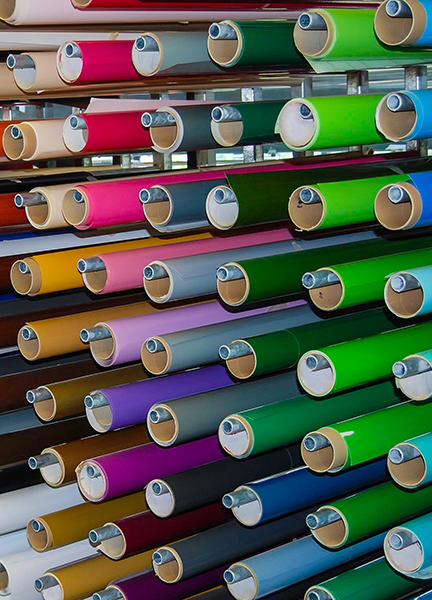
In this instalment of our series on optimising Film Logistics, we’re looking at the sales side of things. After all, a streamlined product range can help to improve logistics – and avoid unsellable stock.
By Fabian Franke, CEO of NEPATA
Today I’d like to raise a point on which I’m sure I speak for many logistics managers: vinyl film resellers really ought to take a closer look at their product range. Is it even possible to offer all these products, with their wide variety of variants, in a way that adds value? Of course, there is pressure from the market to be able to place orders that are as customised and small-batch as possible. But in logistics, this leads to problems that may not have been taken into account when designing the product range. Here, we can turn the tables for once and ask: what would we actually need to sell to ensure that our logistics operations add value throughout the entire process?
The problem with leftover rolls
Here’s an example: Vinyl film is usually sold by the metre. However, this often results in very short leftover rolls. After all, the typical customer doesn’t actually need just a single metre, but three metres or more. As a result, scraps of one or two metres pile up; in some cases, they even end up stacked on top of one another and have to be disposed of – something that was often not taken into account at all when calculating retail prices and margins. Consequently, not only are goods and money wasted, but also a significant amount of space, which makes other goods harder to access or simply incurs costs overall.
Avoid leftover rolls
One might therefore consider streamlining the range, at least for parts of the product range or specific items. Instead of random lengths and widths, there would only be a few ‘standard’ sizes. If, for a 50-metre roll, you only offer five-metre lengths, there will no longer be any ‘remnant rolls’ in the traditional sense. You can also work out in the sales department exactly which widths you actually need to offer. Are the full width of 122 cm, the half width of 61 cm and perhaps 50 cm sufficient? Is the 38 cm width, which may once have been popular, still in frequent demand at all? Another point regarding film width: suppose a customer orders five metres of vinyl film, 61 cm wide. As a rule, five metres are first rewound from the 122 cm-wide master roll, and the five-metre roll is then cut in half. This means: Another five-metre roll, 61 cm wide, is left over for the time being. It is put into storage until the next time something like this is ordered – or a roll that is even shorter. Then perhaps another three-metre roll can be made, but the remaining two metres are left over again. However, if you know that you very frequently sell the 61 cm width in this medium, you can first divide a complete 50-metre roll into two 61 cm rolls and then unroll the individual lengths from them. This way, you’re much less likely to end up with unsellable leftovers: the unwanted two-metre piece will then only appear once, right at the very end of the 50 metres, rather than with every individual section.
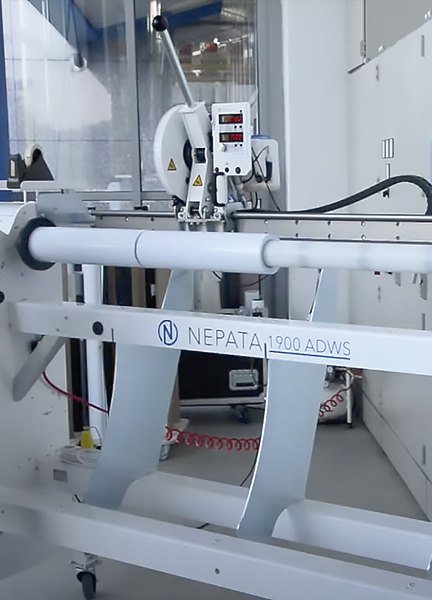
However, this approach means that a larger stock is required and that a higher value of stock must be held for the smaller widths. On the other hand, the advantage is that far fewer unsellable remnants are produced. Perhaps sales staff could also pay particular attention to these widths.
Clear out remaining rolls
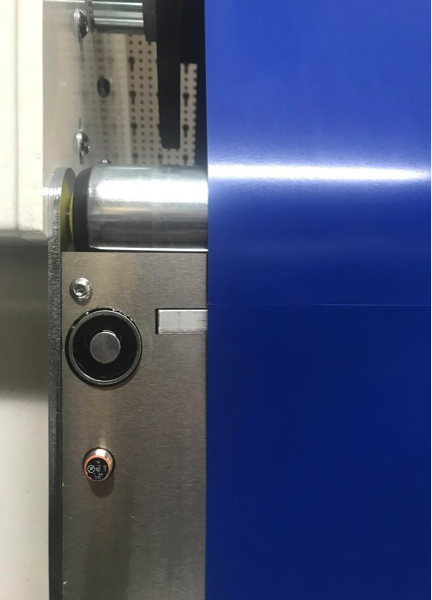
This brings us to the question: what to do with leftover rolls? Often, our customers do not yet have any systems in place to automate the utilisation of leftovers. In other words, finding a way to sell off leftover lengths of one or two metres – which occur quite frequently – through appropriate sales processes, attractive pricing and automated booking into the ERP system. In my experience, there is huge potential here to generate turnover from stock that would otherwise simply have to be disposed of. Another option would be to offer customers a splice – or even ‘threaten’ them with splicing. In that case, a customer ordering a length of more than ten or 20 metres would have to expect splicing, i.e. the medium being joined together. Alternatively, they could be offered a reduced price if they agree to this. In this way, short leftover rolls could be spliced together with longer lengths, thereby keeping stock levels low. Find out more about the splicing function on the NEPATA UA770 rewinding machine and cutting machine in this video.
Consultancy on Film Logistics
I’m sure you’ll also discover further potential once the sales and warehouse teams have had a chance to discuss the matter. Or you could make use of our expertise: as consultants, we can help you optimise your Film Logistics. For 15 years, we have been working with small and large-scale logistics systems for vinyl film converting all over the world. Request further information on ‘Film Logistics Consultancy’ here
More tips in this video
https://www.youtube.com/watch?v=haY0OTJrPsw