
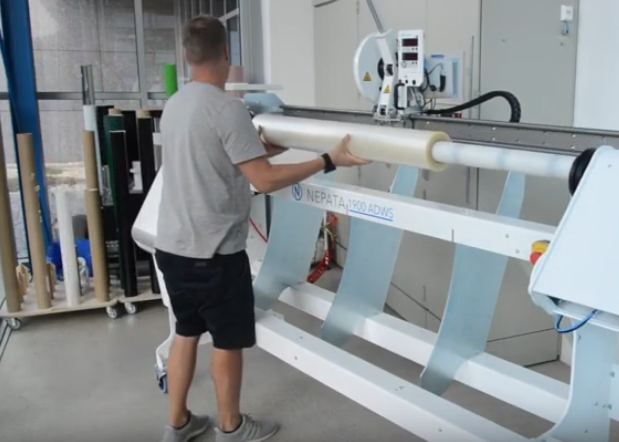
Our tips for greater efficiency in Film Logistics continue. In this instalment: strategies for making better use of your machines’ capacity.
By Fabian Franke, CEO of NEPATA. There is enormous potential to be gained from better organisation of processes when it comes to improving efficiency and, consequently, cost-effectiveness in film warehousing. Following some ideas on reducing walking distances , I would like to share a few observations I have made regarding machine capacity. The aim, of course, is to avoid machine downtime in order to recoup the investment more quickly.
1. Deploy machines in a decentralised manner
If you are using several machines, they do not necessarily have to be located together. It is often better to position them in separate areas of the warehouse. Individual types or ranges of film are then arranged around the machines in such a way that the capacity of each machine is utilised as fully as possible by the stock located in the immediate vicinity.
2. Use runners
How do rolls get from the storage area to the rewinding machine – and back again? Often, the employee operating the machine takes care of this themselves. An alternative is the runner system: a dedicated member of staff brings the vinyl film, clears it away and ensures a fresh supply when a roll is empty after rewinding. The advantage is that the machine can be utilised continuously. This might also be a suitable part-time solution for periods when a particularly high volume of orders is expected. Taking this a step further is the automatic roll storage system we have developed, where robots fetch the rolls.
3. Find the ‘right’ level of tidiness
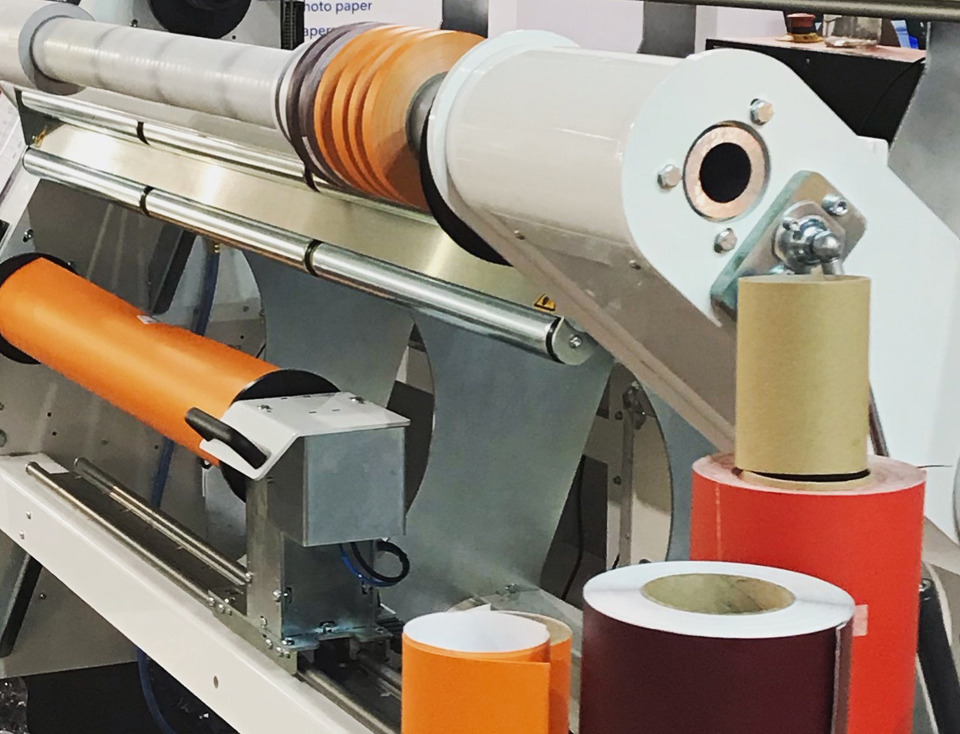
It may seem obvious, but it’s by no means always the norm: make sure the area around the machinery is kept tidy. Do leftover rolls start to pile up around the machines as the day goes on? It then becomes increasingly difficult to move around the area at all and, what is even more serious, it is almost impossible to locate individual rolls, or they are difficult to access amongst the pile. The disposal of core remnants and outer packaging must also be properly organised. Rubbish must not be allowed to obstruct the working area around the machine. We see very good systems in use all over the world, but some companies could certainly do better in this respect. When it comes to storing the vinyl films themselves, we see the full range of solutions: these range from rolls impaled on cantilever racks to “the vinyl film is put back into its plastic sleeve, placed in a cardboard box, and put on the shelf”. Here, it is important to weigh up: how much non-productive downtime—which does not directly add value—is involved in these processes for packaging and, where applicable, labelling. The aim must be to get both the vinyl film and the staff back to the machine more quickly. Get personalised advice We can help you optimise your film logistics. Our consultancy on Film Logistics and digitalisation is entirely practical in nature and is independent of whether you use NEPATA machinery. Request further information on “Film Logistics Consultancy” here
More tips in this video
https://www.youtube.com/watch?v=haY0OTJrPsw