
If a machine pays for itself in just a few years. If the return on investment is several hundred per cent. Then it’s a no-brainer to buy that machine, says Nepata CEO Fabian Franke.
By Fabian Franke, CEO of NEPATA, June 2024
Summary
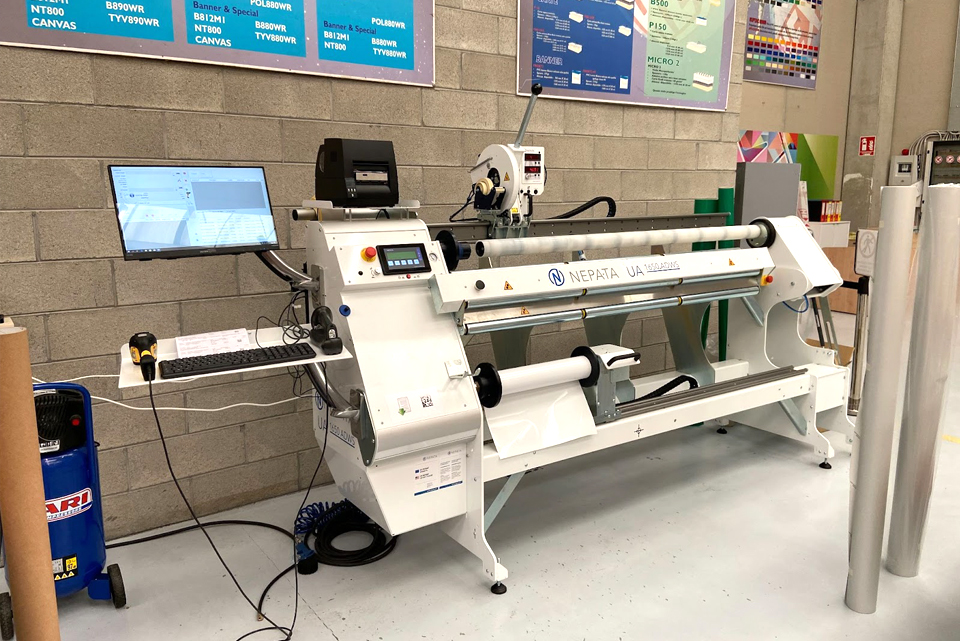
Experience shows that the productivity gains achieved with Nepata’s rewind and cutting-off solutions amount to 40 per cent or more compared with basic equipment for converting. This article illustrates this using the example of the UA 1650 ADWS, Nepata’s best-selling machine. Even if the machine saves just one hour a day for a warehouse worker, it will have paid for itself in no more than five years – with a service life of well over 10 years. In fact, the potential savings are even greater, because the precision converting centre also prevents material wastage, errors and complaints, whilst improving the workflow in the warehouse.
Converting vinyl film – expensive manual labour or expensive machinery?
Anyone who does not convert film media on an industrial scale faces a dilemma: should one opt for expensive manual labour or expensive machinery? In principle, simple devices are sufficient for rewinding, length trimming and slitting. But the manual work involved makes the business a labour-intensive one. And it eats into profitability. After all, warehouse staff have to be paid a high wage – if you can find them at all. On the other hand, an investment in greater automation – specifically, a rewinding and cutting solution costing the equivalent of a mid-range car – is also a significant financial burden to bear.
However:
If you take a closer look, the supposedly expensive machine suddenly becomes very good value for money.
I would like to illustrate this using the example of the Nepata UA1650 ADWS precision centre for converting.
Scenario 1: If the machine saves just one working hour a day …
Our example warehouse operator, Max, earns an hourly rate of around 35 euros for one productive hour’s work here in Germany. This figure already takes into account holidays, sick leave and unproductive time such as training sessions, meetings, etc. In an average month, he works 18 to 19 working days. If Max saves just one hour a day on converting tasks by using the Nepata UA1650 ADWS, the machine will have paid for itself after five years. At an average utilisation rate, significantly greater labour savings – perhaps as much as double – should be possible. For that reason alone, the machine would have paid for itself after 2.5 years. Moreover, the machine easily has a service life of ten years or more.
Empirical figure: 40 per cent increase in productivity
I gather from users’ experiences that saving one to two hours a day is entirely realistic. These experiences show that:
Productivity gains achieved with Nepata’s rewinding and slitting solutions amount to 40 per cent or more compared with standard converting equipment.
This means that the machines in the Nepata UA series are among the most efficient and productive conversion solutions for film media worldwide. In particular, when combined with the ConvertPlus control software, they can carry out cutting operations quickly.
How Nepata machines achieve high productivity
First of all: this list is not exhaustive, and I do not wish to go into technical details here. However, I would like you to understand where the potential for productivity lies.
- Nepata machines run fast.
The winding speed is up to 1.5 metres per second.
- Nepata machines are cleverly designed.
This saves time, for example, when clamping and unclamping cores and rolls.
- Nepata machines feature a high degree of automation.
First and foremost, we should mention automatic length trimming – following, of course, a precise automatic length measurement during the rewinding process.
- Nepata machines are software-controlled.
The use of our in-house control software delivers a massive boost to productivity. This optimises production processes by being directly linked to your ERP system. For example, several orders for the same material – say, a black adhesive film – can be combined across multiple delivery notes. Our example worker, Max, only has to retrieve the relevant master roll from the shelf once, load it and process it, rather than handling it several times per shift. This is because, using the ‘traditional’ method, he would probably have worked through the delivery notes one by one, without realising that he would need this material more often later in the day.
Generating more orders with the same number of staff
But what will warehouse assistant Max do with the time he saves? Believe me, he won’t be bored. Because let’s be honest: your warehouse team is probably already struggling to keep up with the orders as it is…
Your staff member will be able to process more orders in the same amount of time – orders that you may previously have had to turn down.
The return on investment is already continuing to rise.
If employees are now relieved of some of their workload through greater automation and software support, this reduces stress. Ultimately, this means fewer sick days and lower staff turnover. And so the ROI rises once again. After all, downtime is just as unprofitable as finding and training new staff.
Scenario 2: If the machine only reduces material waste by 2 per cent…
Let’s move away from working hours and look at the material. Thanks to the high measuring accuracy of our machines, the following applies:
They charge the customer for five metres and deliver five metres – no more and no less. In the end, they sell 50 metres from a 50-metre roll.
With simpler rewinding machines, a small amount of extra material is required with each winding operation to ensure that the customer is not supplied with a roll that is too short. However, this means that at the end of the roll there will no longer be a full metre left, but rather an unsaleable remnant. Let’s assume that only 49 metres can be sold from each 50-metre roll. This corresponds to two per cent waste of the total film volume. With an annual purchase volume of 500,000 euros, the Nepata UA machine generates savings of 10,000 euros by preventing material wastage. This means the machine pays for itself by the end of the fourth year of operation – solely as a result of this effect.
Fewer errors and greater profitability with software support
And – as you might expect – there is even more potential for savings when it comes to materials: with the help of the ConvertPlus software, typical errors can be avoided. Such as sending rolls that are too long or too short, the wrong colours, matt instead of gloss, and so on. Or, for example, six metres might be unwound from a ten-metre roll for a customer, but the customer is sent the remaining four-metre roll because an employee made a mistake. In short: errors that lead to customer complaints, tie up capacity, increase material consumption and thus erode profitability.
Here’s how our control software helps to prevent errors:
- ConvertPlus automates the data entry process on the machine, so you can’t make typing errors or leave anything out.
- A key feature of ConvertPlus is that barcode scans are used to match the material against the actual order, ensuring that there can be no mix-ups.
A positive side effect: optimisation of warehouse logistics
As an added bonus, ConvertPlus provides you with a tool for improving warehouse logistics. Here are just three aspects briefly outlined:
- Overview of stock levels
The barcode labels mentioned above allow you to check at any time how many metres are left on a roll. This helps you to choose a roll that still has a ‘useful’ amount left, rather than unsellable short rolls. ConvertPlus also offers the option of exporting data from jobs that have been completed when it comes to converting your stock levels back to your ERP software. This allows you to keep track of your stock levels in real time.
- Avoiding stock build-up
It is also possible to record the date a material was received. This allows it to be processed on a ‘first in, first out’ basis before it becomes unusable and has to be disposed of.
- Making a successful complaint to the manufacturer
Tracking batch numbers helps you to successfully pursue claims against film manufacturers in the event of material defects.
Conclusion: Converting can be profitable – with the right investment.
The time saved alone makes purchasing a rewinding and slitting machine from the Nepata UA series highly cost-effective. The reduction in material waste alone leads to a rapid return on investment. On top of this, there are further optimisations relating to the complaints process and warehouse logistics which can be realised and which add up financially over the years. When all these benefits are considered together, the result is a return on investment of several hundred per cent. The Nepata UA1650 ADWS centre for converting pays for itself in just a few years. Or to put it another way:
Buying this machine is a no-brainer. Anyone who doesn’t buy it has no business sense.
And beyond the financial aspect: the improved workflow lays the foundation for satisfied staff, long-term customer relationships and, ultimately, growth.
Would you like to boost the profitability of your converting processes? Book a short presentation here on the workflow using Nepata’s machinery and software …